
El Paso Release Date Meanings
Three dates can appear during a Texas prison case, and each answers a different question. TDCJ defines a projected release date as the date calculated by Classification and Records when a person is expected to leave incarceration if parole does not happen sooner. It is a calculation, not an appointment. The applicable formula depends on the offense, offense date, sentence, mandatory-supervision eligibility, and credited time.
A scheduled release date and scheduled release location may appear later. TDCJ posts them after a favorable release path, plan and certificate have moved through review and an audit. Even then, TDCJ warns that the date can change without notice, including on the planned day. An actual release is the completed event. Confirm it through a past date plus current status, incarceration history, parole status, or an agency record.
| Record label | What it means | What it does not prove |
|---|---|---|
| Parole eligibility date | The earliest point at which the case may be considered. | Approval or a date of physical release. |
| Projected release date | TDCJ's current calculation for leaving incarceration if parole does not occur first. | A firm appointment or completed exit. |
| Scheduled release date | A later operational date after required approval and processing. | That no last-day change can occur. |
| Maximum expiration or discharge | The sentence endpoint absent some other authority. | That an earlier parole release did not occur. |
Search El Paso TDCJ Dates
The TDCJ Offender Information search is the correct public tool when an El Paso County case led to a Texas prison or state-jail commitment. It is not an archive of county jail releases. Someone transferred from the Downtown Detention Facility to TDCJ has changed custodians, not entered the community. Someone who never received a TDCJ sentence may not appear in the state system at all.
- Search with the seven-digit TDCJ number or State Identification number when available. Otherwise use the most exact name and supporting identifiers.
- Open the matching detail record. Compare identity, sentencing county and court, present and prior offenses, sentence length, location, and status.
- Read the projected release and parole-review fields in context. Look for a scheduled date and location only if TDCJ has posted them.
- Check whether the result says prison custody, parole, mandatory supervision, or discharge. A move between TDCJ units is not release.
- When the online result is unclear, contact Classification and Records at 936-437-6231 or classify@tdcj.texas.gov, or use the formal TDCJ public-information channel.
The matching screen should be read beyond the result row. Open the official TDCJ offender search to compare the complete public detail.
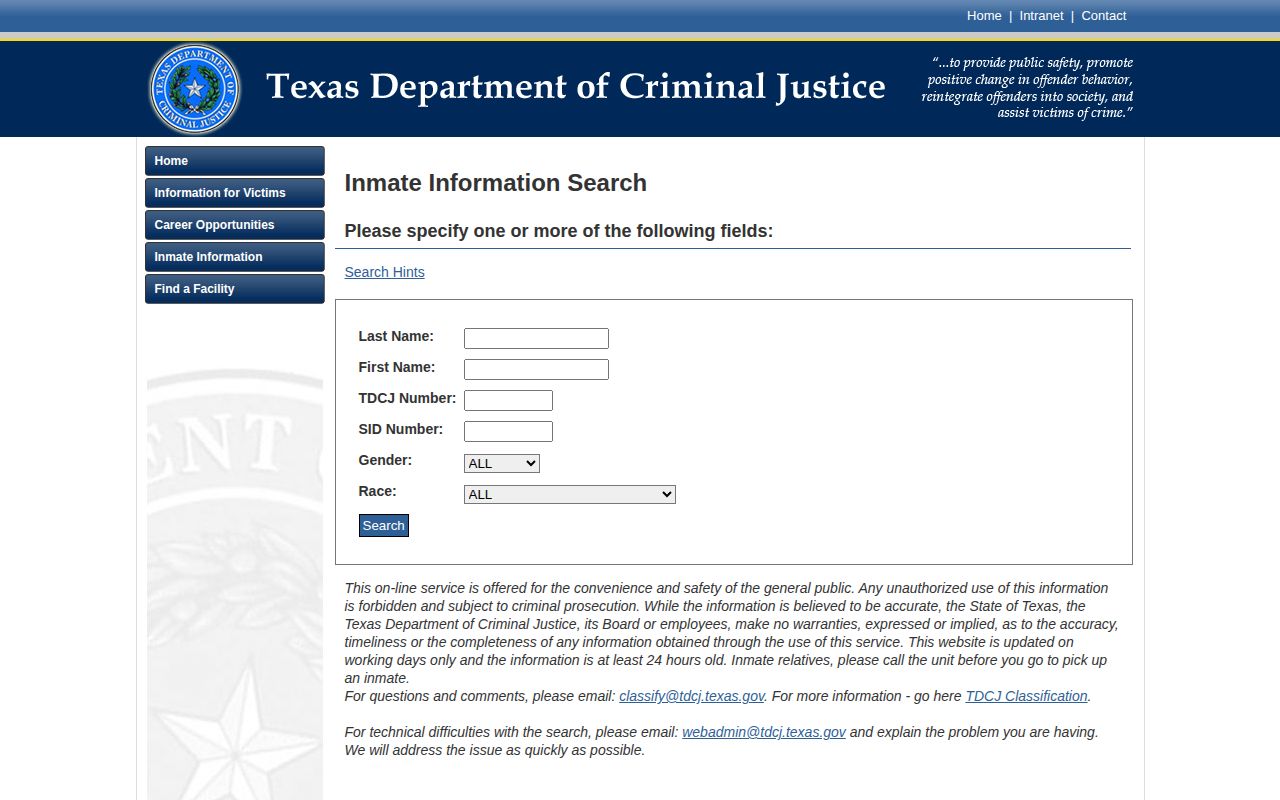
The state screen is useful for Texas prison and state-jail sentences, while El Paso County jail and federal records remain in their own systems.
El Paso County Jail Dates
County custody follows a different path. The El Paso County Jail Records tool is expressly limited to current jailings. A person awaiting trial does not have a computed prison-release date. Bond, a court order, dismissal, another case, a warrant, a detainer, and the jail's release process can all affect when the booking ends. A posted bond shows a legal mechanism, but it does not prove the moment of physical exit because another hold may remain.
For a sentenced county detainee, the judgment and court docket establish the sentence terms. The jail's booking-and-release record establishes the actual exit and disposition. Search the El Paso criminal case, then call Downtown Detention Facility Releasing at 915-273-3768 when immediate confirmation is needed. A focused request to EPCSO Crime Records should ask for the actual release date and time, type, authority, holds, and destination or receiving agency.
County good conduct is governed by Texas Code of Criminal Procedure Article 42.032. The sheriff may award deductions to eligible county prisoners for orderly conduct and obedience, and may restore forfeited credit. The research does not establish a person-specific calculation. Court credit, local records, and sheriff administration must be checked together.
Note: A county jail no-match begins a release inquiry; it does not establish a release date.
Texas Release Credit Rules
Texas has no universal rule that every incarcerated person must serve 85 percent of a sentence. That claim flattens an offense-specific system into a false promise. The governing rules depend on the offense, offense date, sentence structure, parole eligibility, and mandatory-supervision law. TDCJ applies the controlling statutes and commitment data to each record.
Government Code Chapter 498 governs state good-conduct time. Good time can affect classification, parole or mandatory-supervision calculations where the law permits, but it is not the same as flat time actually served. It also does not reduce the sentence itself. Disciplinary loss may change the relevant date, and forfeited state good time is not generally restored. Government Code Chapter 508 controls parole and mandatory-supervision rules, including offense-based limits and discretionary review.
- Flat time
- Calendar time actually spent in custody.
- Good time
- Credit administered under law and agency rules; it is not a day-for-day promise of early release.
- Parole
- Conditional release from prison while the sentence continues under supervision.
- Mandatory supervision
- A statutory release route that also continues the sentence under supervision and may require Board approval.
For eligible offenses before September 1, 1996, the projected date generally reflects when flat time plus good time equals the sentence. For an eligible offense on or after that date, discretionary mandatory supervision also requires Board approval. A denial may recalculate the projection to maximum expiration. A noneligible case usually projects to maximum expiration unless parole occurs earlier.
Why El Paso Dates Change
A projected release date is recalculated as authoritative facts change. The public value may move forward or backward. Some changes affect eligibility, while others affect the operational schedule after approval.
| Factor | Possible effect |
|---|---|
| Disciplinary action | Loss of good time or status can alter a statutory calculation. |
| New commitment or audit | Corrected sentence, offense, credit, or court data can produce a new date. |
| Parole decision | Approval may permit earlier release; denial can leave or revise the projected endpoint. |
| Mandatory-supervision review | Required Board approval or denial affects eligible later-offense cases. |
| Release plan or program | Housing, required treatment, certificate processing, or program completion can delay scheduling. |
| Detainer or hold | Another agency may assume custody even when TDCJ or EPCSO books the person out. |
Parole approval is not the actual date. Review and Release Processing, Classification and Records, the plan, conditions, and certificate still matter. A residential reentry-center placement in El Paso means the person has left prison but remains in a structured, supervised setting.
No Texas 85 Percent Rule
This distinction is central to an El Paso County release date lookup. A percentage copied from another state or offense category cannot replace the TDCJ calculation. The official TDCJ definitions separate parole eligibility, projected release, scheduled release, and maximum expiration. Each label rests on a particular legal and records stage.
TDCJ also states that scheduled dates can change without notice on release day. State mandatory releases falling on a weekend or legal holiday are generally scheduled for the preceding business day, and standard TDCJ releases generally occur on weekdays during published daytime hours, subject to change. That state-prison policy is not evidence of an EPCSO weekend rule. Family planning for a Sanchez Unit release should call the unit before travel.
Note: A general sentence percentage cannot establish one person's lawful release timeline.
Confirm El Paso Actual Release
After the anticipated date passes, recheck the correct system. TDCJ status may show parole, mandatory supervision, discharge, continued custody, or a new location. Parole and mandatory supervision mean physical prison custody ended while TDCJ Parole Division authority continues. Discharge or maximum expiration indicates sentence completion, subject to any separate custody. The complete parole file is not public because Government Code Section 508.313 protects parole information.
Texas IVSS provides notifications, but county and state registrations are separate. The county product can alert on an EPCSO release or transfer. The state IVSS portal covers prison custody, parole, Board actions, and discharge. Neither alert replaces the originating record. Use the VINE Inmate Check workflow to choose the right current Texas portal, then obtain the jail or TDCJ record if an exact actual date is required.
Federal and immigration cases also remain separate. A BOP release means the person left BOP custody, not necessarily all custody or supervision. An EPCSO transfer to ICE is not a community release. The agency that held the person at the relevant time is the one that can verify the event.