
El Paso Three-Day Release Search
The county records hub expressly calls Jail Records “current jailings only.” No official 72-hour or recent-release feed was located. Search the live roster to learn whether the person remains listed, then confirm what ended the booking. A missing name is a lead, not proof.
A three-day window allows more time for public records to post and captures changes around weekends. It also raises the risk of confusing people with similar names. Match the birth date, booking number, cause number, and facility wherever possible.
Build El Paso Release Timeline
Use three calendar days as the request range, not as a filter the county claims to offer.
- Search current Jail Records by name and birth date.
- Check Jail Bond Records for the date and status of any bond.
- Read the criminal docket for orders, dispositions, and sentence events.
- Ask EPCSO Crime Records for the booking-and-release record covering the range.
- Follow a transfer through TDCJ, BOP, or ICE instead of treating it as community release.
Use 24-Hour Releases when only today's change matters.
El Paso Release Record Fields
Request exact event fields because no public three-day table supplies them.
| Field | Use |
|---|---|
| Booking number and facility | Identifies the custody episode. |
| Actual release date and time | Places the event in or outside the window. |
| Disposition and authority | Explains bond, time served, court order, parole, or another basis. |
| Destination or receiving agency | Separates community release from transfer. |
| Hold resolution | Explains why another agency may retain custody. |
Ask the custodian to cite the authority for a withheld or redacted field. Not every requested item is necessarily public.
El Paso Weekend Release Checks
The Detention Bureau works around the clock, yet El Paso County publishes no adult standard exit hour. Weekend court action, paperwork, identity checks, unresolved detainers, transport, and receiving-agency handoffs can cause records to appear out of sequence. DDF Releasing at 915-273-3768 is the best immediate human channel.
The 72-hour method is useful precisely because it does not assume a same-day web update. Preserve the time of each search and compare it with the formal release event later.
El Paso Release Fallbacks
Texas IVSS-Counties can send release and custody alerts, but it warns that a former-custody person may disappear and that portal data is not an official record. A TDCJ search covers state prison and state-jail status, not a completed EPCSO booking. BOP and ICE each cover their own custody.
The official current-only form below remains the starting point. Open El Paso Jail Records to compare the person's identifiers.
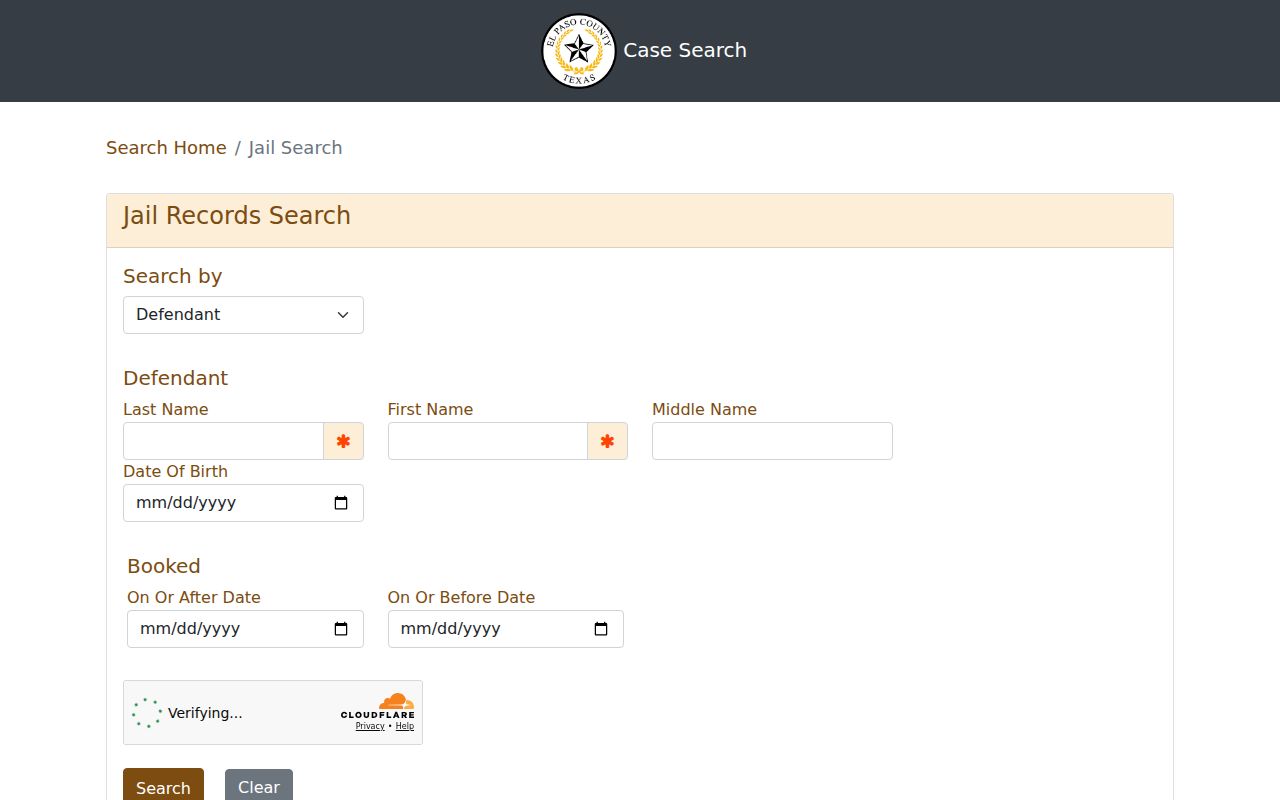
The screenshot shows why a separate booking-and-release request is needed for history.
Trace El Paso Custody Transfers
An EPCSO booking can close because another authority takes custody. That is release from county control, but not a return to the community. El Paso's local setting makes the distinction crucial. The Downtown facility handles federal arrestees, the Annex stopped housing federal inmates in May 2024, and two local facilities hold people for ICE.
Search the TDCJ offender system after a state transfer. For federal custody, consult the BOP locator. The ICE locator can show qualifying current and recently booked-out immigration records for a limited period.
Compare the county record's destination with the receiving system. If facts conflict, ask the originating jail for clarification rather than assuming the newest public screen is complete.
Preserve El Paso Release Proof
Save the booking number, cause number, search date, and any IVSS event notice. Then request the actual release date and time, release type, authority, destination, and detainer resolution. This creates a clear chronology without treating a changing web result as a permanent archive.
A bond entry describes a legal mechanism, not the final door time. A court disposition may explain why custody should end, but the jail event proves when that booking ended. Read the records together.
Note: The roster, bond record, court docket, and release record each answer a different question.