
El Paso Parole Versus Probation
Texas separates the decision to release a state prisoner from the work of supervising that person. The Texas Board of Pardons and Paroles decides parole and discretionary mandatory-supervision cases. The TDCJ Parole Division identifies eligible cases, processes release plans and certificates, and supervises people after prison release. El Paso County Community Supervision and Corrections Department, or CSCD, handles probation ordered by a county or district court. Criminal Justice Coordination has a third role: conditional pretrial release before adjudication.
These labels cannot be swapped. A person may leave an El Paso County jail on probation without ever entering TDCJ. A state prisoner may return to El Paso County on parole without being a county probationer. Someone on pretrial supervision has not yet reached a final conviction or sentence in that case.
| Path | Who orders it | Who supervises it | Best first check |
|---|---|---|---|
| Parole | Board panel after prison review | TDCJ Parole Division | TDCJ detail and BPP status line |
| Probation | Trial court | El Paso County CSCD | Court record and CSCD |
| Pretrial supervision | Court before case disposition | County Pretrial Supervision | Bond, case, and supervision records |
- Parole
- Conditional community supervision after release from a prison sentence.
- Probation
- A court-ordered sentence served under community supervision instead of, or after, confinement.
- Discharge
- The formal end of the sentence or supervision term.
- Absconder
- A person alleged to have stopped reporting or whose location is unknown.
Check El Paso Release Supervision
Start with custody history. El Paso County's jail search is current-only, so it cannot prove that a former detainee is now supervised. The full El Paso County released-inmate search path helps establish whether the jail event was release, transfer, or another change. Once the path is known, use the matching supervision source.
- For a TDCJ sentence, search TDCJ Offender Information. Prefer the seven-digit TDCJ number or SID, then compare name, date of birth, offense, county, court, and location.
- Open the detail record and read Parole Review Information. Do not treat an approval vote as proof that physical release occurred.
- Call the BPP Parole Status Line at 844-512-0461 with the name, TDCJ or SID number, and date of birth when the posted record needs context.
- For court probation, check the El Paso criminal case disposition and contact the correct CSCD location.
- For conditional release before adjudication, compare the jail bond and case records, then contact County Pretrial Supervision.
After a favorable parole vote, Review and Release Processing plus Classification and Records must still validate eligibility, the release plan, conditions, and the certificate. That work can separate the Board decision from the actual release date. Public staff also may limit what they disclose, so request the underlying record when formal proof is needed.
El Paso Supervision Office Routes
El Paso has two district parole offices and four published CSCD locations. The office split is practical, not cosmetic. District parole offices serve prison-release supervision. CSCD offices administer court probation. The assigned office, not simply the nearest address, controls the case.
TDCJ El Paso District Parole Offices
El Paso I DPO (DRC)
13 Founders Blvd.
El Paso, TX 79906
915-778-4233
El Paso II DPO
15581 Horizon Blvd.
Horizon City, TX 79928
915-852-7219
The TDCJ Region V office directory is the source for current district office details. Reporting frequency is set in the supervision process and can change. No single check-in schedule applies to every released person.
El Paso County CSCD
Central/Downtown
800 E. Overland Ave., Suite 100
El Paso, TX
915-273-3344
Other official locations are Eastside, 2350 George Dieter Dr., Suite C, 915-538-1640; Northeast, 4641 Cohen Ave., Suite C, 915-751-7761; and Northwest, 435 Vinton Rd., 915-886-1040.
County Pretrial Supervision is at 800 E. Overland Ave., Suite 122, 915-273-3353. It supervises eligible misdemeanor and felony defendants released under court conditions through adjudication. Its record can support the type of release, but it does not replace the jail's physical booking-out time.
El Paso Parole Review Process
Texas does not hold a conventional formal hearing for ordinary parole or mandatory-release consideration. There is no public daily inmate hearing calendar to check. TDCJ Parole Division identifies a case about six months before initial eligibility and about four months before a later review. An institutional parole officer interviews the prisoner, prepares a case summary, and sends required notice. Three panel members then review and vote the file one after another. Two matching votes decide the result.
Results appear in TDCJ Parole Review Information or through the BPP status line. A denial includes a next review date. A favorable code may still require a program, a set period, an approved plan, or release processing. The Board vote-options page defines FI, RMS, NR, Serve-All, and other codes. Eligibility under Government Code Chapter 508 permits review; it never guarantees release.
Revocation is different. It may involve a hearing after an alleged violation, while initial parole consideration is a file review. BPP says revocation decisions commonly take two to four weeks. Keeping these processes apart prevents a review date from being mistaken for a release date.
View the official Board decision terms shown in the state results material.
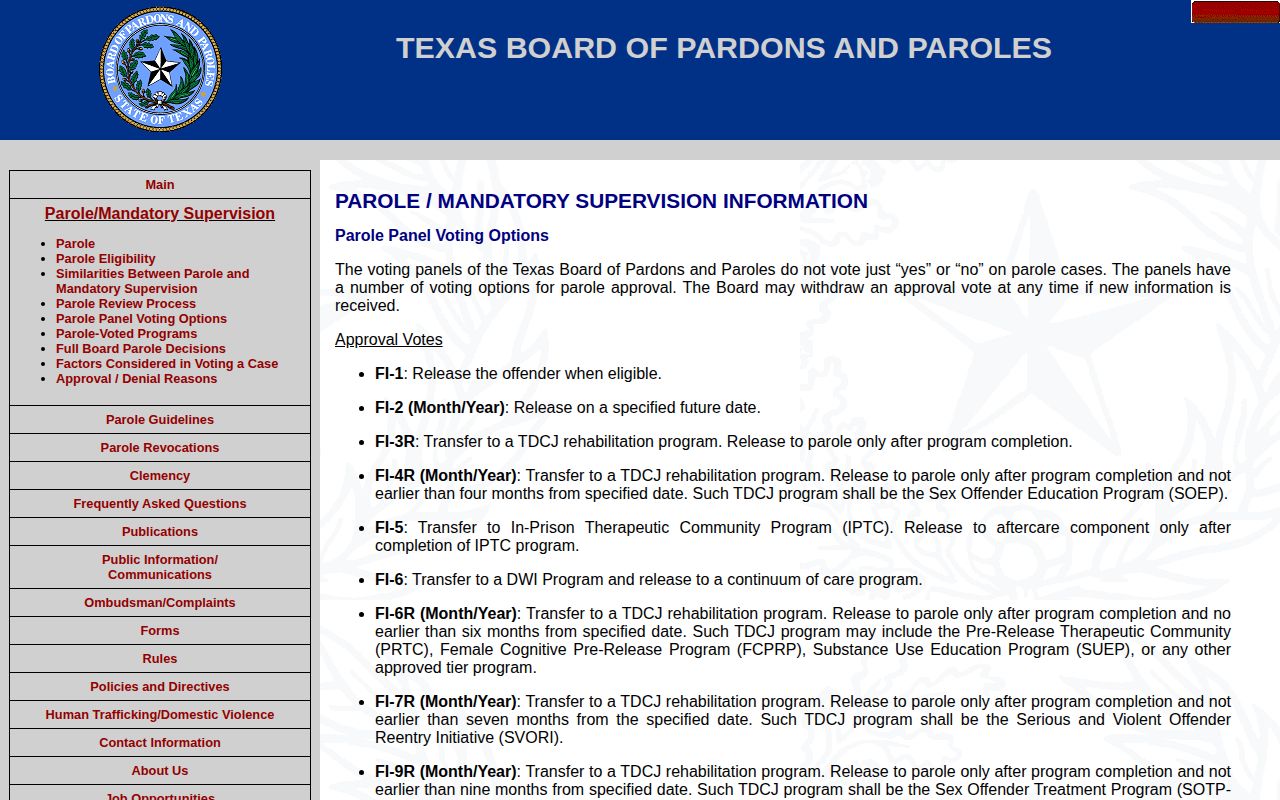
The official terminology shows why a favorable result may still depend on a program, timing condition, or approved release plan.
El Paso Supervision Violations
Conditions vary by case and may include reporting, approved residence, treatment, travel limits, fees, or other terms stated in the order or certificate. A violation allegation is not itself a final revocation decision. Contact the assigned officer or court for the operative condition and current case posture.
TDCJ Fuginet is restricted to authorized law enforcement. It is not a public absconder lookup. Public users can check TDCJ status, call BPP, contact the assigned DPO, and consult El Paso County's separate warrant search when it applies. A county warrant does not by itself prove that TDCJ classifies someone as a parole absconder.
Texas IVSS can provide notice of some state custody and parole changes, but it is not the parole file. Government Code section 508.313 protects parole information beyond what official public status and Board result channels disclose.
El Paso Reentry After Release
El Paso County publishes Jail Annex programs that include resource classes and care management for specified justice-involved groups. Some education may continue after release. County planning has also described direct transport of some unhoused releases to Rescue Mission. El Paso Promise offers a more limited referral path for eligible young adults. These are local options, not benefits guaranteed by parole or probation status.
The two Horizon Boulevard residential reentry centers require another distinction. A resident has left prison but remains in a controlled residential placement under TDCJ supervision. That is not an unrestricted discharge. Verify the placement through TDCJ status and the responsible district parole office.
El Paso Release IDs and Property
TDCJ reentry staff may help eligible state prisoners obtain a replacement Social Security card, certified birth certificate, and state identification. That state service should not be promised to a person leaving an EPCSO jail. The release systems and eligibility rules differ.
El Paso's Juvenile Detention Center has its own property rule: property left more than 30 days after release is forfeited without notice. That warning applies to the juvenile center, not all adult county releases. Adult evidence pickup follows a different process and often needs case-agent approval and an appointment.
El Paso Supervision Discharge
Supervision ends through the authority controlling it. TDCJ parole or mandatory supervision can reach discharge when the applicable sentence and legal conditions are satisfied. County probation ends through the court and CSCD record. Pretrial supervision ends with a court change or adjudication, not a TDCJ discharge.
Confirm the end date with the agency record. A person may be out of jail yet still supervised, or out of one form of supervision while another case remains. Texas Public Information Act requests may reach releasable status records, but Chapter 508 protects the full parole file. Ask narrowly for the status, effective date, supervising authority, and discharge record rather than assuming every case note is public.